


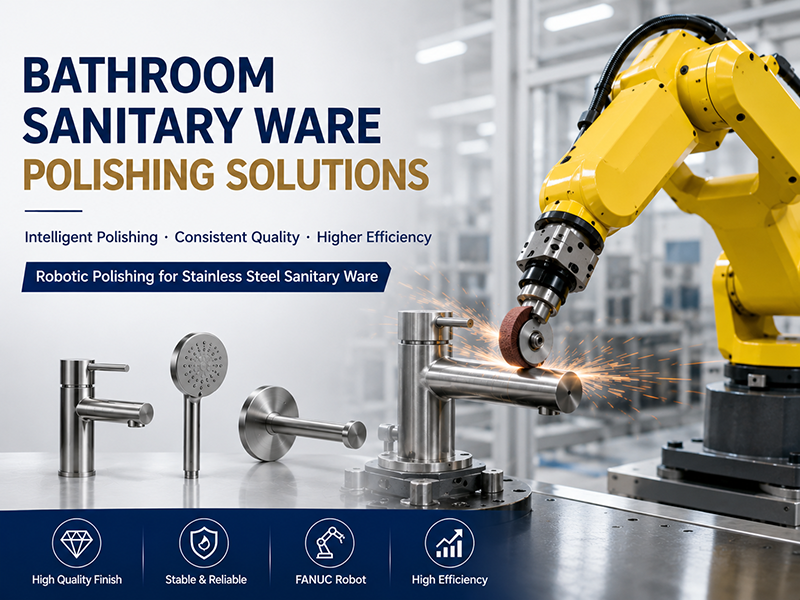
The 8 Core Pain Points of Automated Grinding for Stainless Steel Bathroom Hardware & Industry Solutions
Unpredictable Position Deviation Caused by Welding Deformation
After welding, thin-wall stainless steel parts (1–2mm) can deform by several millimeters in random, irregular directions. When robots follow fixed paths, the actual weld position deviates significantly. Once beyond the force-control float range, over-grinding or missed grinding occurs frequently, leading to massive rework.
Limited Force-Control Stroke Cannot Cover Large Deformation
Conventional contact wheel force control only offers ±2mm float. When deformation exceeds this range, the system hits hard limits: outward bulges cause burn-through, while inward recesses result in no contact. The root cause is that force control only manages pressure after contact and cannot resolve position deviation before contact.
Heat Accumulation Causes Burning and Thermal Deformation
304/316 stainless steel has low thermal conductivity, so grinding heat builds up rapidly. Excessive feed speed or pressure causes instantaneous high temperatures, surface discoloration and burning. Thin-wall parts may also suffer dimensional deviation from thermal stress, resulting in direct scrapping.
Complex Programming Lengthens New Product Launch Cycles
Faucets feature complex curved surfaces and numerous teaching points. Each grit size of abrasive belt requires separate programming. Under high-mix, low-volume production, senior engineers are tied up with repetitive work, dragging down line changeover efficiency.
Frequent Changeovers Reduce Equipment Utilization
Different product models require different fixtures. Each changeover involves disassembly, adjustment and coordinate recalibration, with zero output during setup—eroding the economic benefits of automation for small-batch orders.
High Risk of Collision from Misoperation
Misaligned workpieces or coordinate drift can trigger rigid collisions, damaging belt grinders, fixtures and even workpieces, while also degrading robot repeatability.
Abrasive Belt Wear Erodes Quality Consistency
Cutting performance differs greatly between new and used belts. Chip clogging and uneven wear cause Ra value fluctuations and may even generate frictional overheating, rendering process parameters ineffective.
Difficulty in Maintaining Stable Quality
Incoming material variation, belt wear and parameter drift together reduce surface roughness consistency. Corners and edges of irregular parts are especially hard to grind uniformly, keeping final inspection rejection rates high.
Core Breakthrough Logic: Perception + Force Control
The recognized industry upgrade path adds a "perception layer" before traditional force control. Laser line scanning captures the actual workpiece profile to dynamically correct grinding paths, which are then refined by precise force control. Combined with active cooling, modular programming, standardized fixturing and full-lifecycle belt management, this approach systematically solves all eight pain points.